There’s an odd thing about the word enough: most of us want it, but very few of us know how to recognize it.
Think about it. How much money would make you feel secure? How much success would make you feel accomplished? How many square feet would make the house feel big enough? How many people need to notice your work before you stop wondering whether you’ve done enough? Maybe your version has nothing to do with money. Maybe you want enough peace, enough approval, enough experiences, enough certainty, or enough proof that your life is headed somewhere good.
Now ask the harder question: If you reached it, how would you know?
That question can get uncomfortable because the finish line has a way of moving. The salary that once sounded incredible becomes the normal monthly budget. The phone you couldn’t wait to buy becomes the old phone. The accomplishment you imagined would change everything eventually becomes a line on your résumé. We adjust quickly. Then a new version of “more” appears.
There is nothing strange about wanting a good life. We want security because insecurity is exhausting. We want our work to count because meaning is deeply human. We want beauty, comfort, friendship, experiences, and enough money to care for ourselves and the people we love. Those are real desires. The more interesting question is what we expect those things to do for us.
Are you asking money to remove fear? Are you asking achievement to prove your worth? Are you asking possessions to tell the world something about you? Are you asking the next milestone to give you the sense of arrival the last one couldn’t provide?
Those questions are worth sitting with before rushing toward answers.
Jesus once said, “One’s life does not consist in the abundance of his possessions” (Luke 12:15). Even if you’re still deciding what you think about Jesus, that is a fascinating claim. He is separating the amount a person owns from the quality and meaning of the life they are actually living.
A few sentences later, Jesus tells a story about a wealthy man whose land produces more than he can store. His solution is straightforward: tear down the barns, build bigger ones, store everything, then finally relax. His internal script is familiar: once I have enough saved, enough stored, enough security around me, then I can exhale.
The problem is that he never gets to enjoy the life he keeps postponing.
Jesus ends the story by asking us to reconsider where richness is actually found. The point reaches beyond a warning about having too much stuff. It presses on the assumption beneath the man’s life: more will eventually make me safe enough to start living.
That assumption is still alive.
Maybe one way to discover whether you have enough is to look at what your pursuit of more is costing you. What gets less of you because something else keeps demanding more? Your time is finite. So is your attention. Your energy is finite. Your years are finite. Every yes spends something.
More possessions require more care. More ambition can require more hours. More comparison requires more attention to someone else’s life. More chasing can leave less room for the people sitting right in front of you.
What if enough begins when you become clear about what you want your finite life to be spent on?
That brings us back to Jesus. His invitation was never simply to become less attached to things for the sake of having fewer things. He kept pointing people toward a life centered on love of God and love of neighbor, generosity, trust, service, and a kingdom larger than the one we can build for ourselves. His teachings about money make more sense when viewed through that lens. He seems to be asking: What if the thing you’re gripping most tightly is keeping you from the life you actually want?
You may not be ready to answer that in religious language. That’s okay. Start with the question. What has “more” promised you? Has it delivered? What might change if your sense of enough came from somewhere deeper than the next acquisition or accomplishment?
And if you’re willing, take the question one step further: Could the life Jesus describes actually be freer than the one you’ve been trying to build?
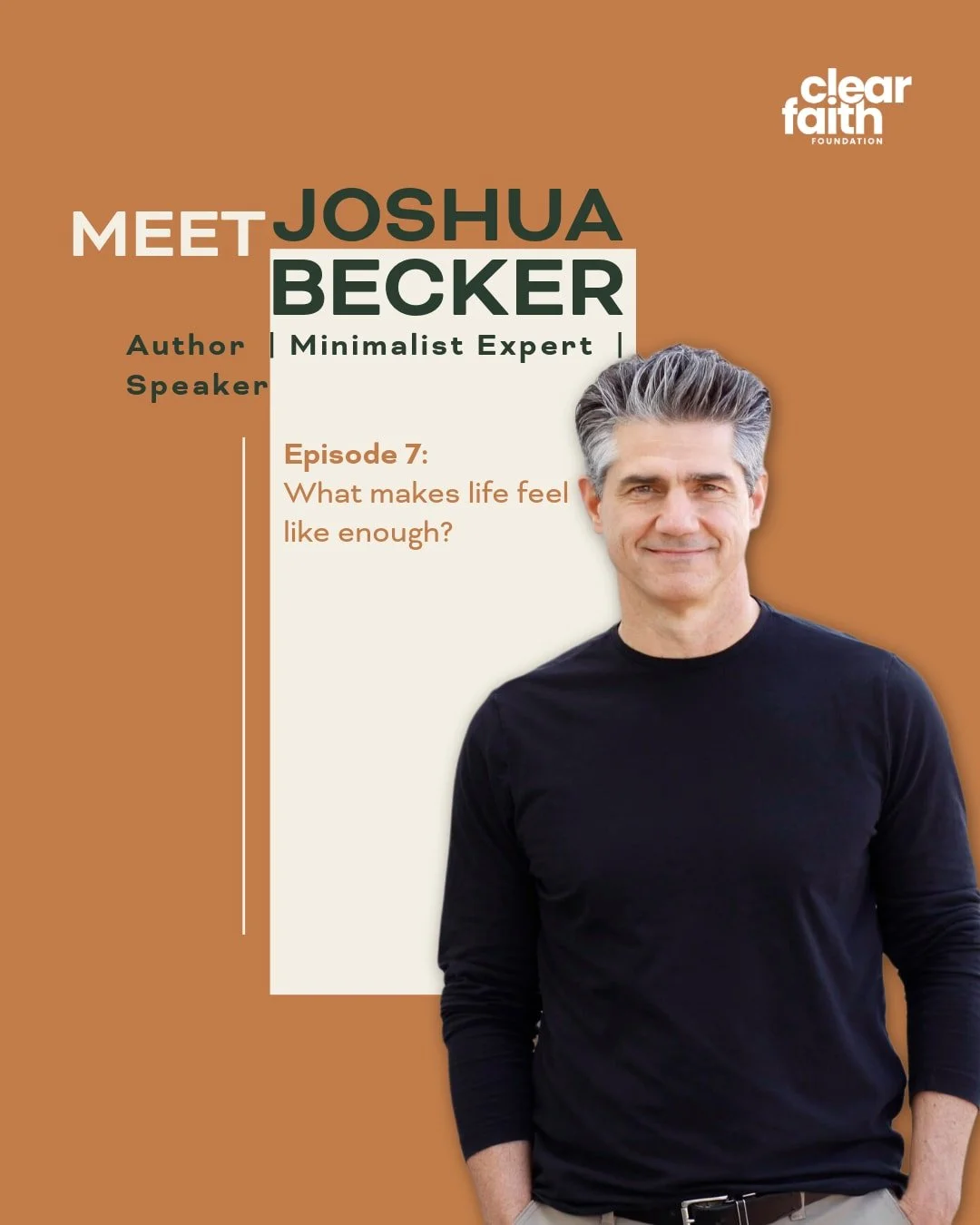
This week, Joshua Becker told Bobby McGraw that minimalism eventually changed the way he understood Jesus’ teachings about money and possessions. He had known those teachings for years, but living with less helped him see them as an invitation to a better life, with more room for generosity, relationships, service, and joy. Joshua Becker .title.edits.soci…
That may be a good experiment for the week ahead. Pick one area where “more” has had a strong pull on you and ask what it is promising. Then ask what might become possible if you needed a little less of it.
You may discover that enough is less of a number you reach and more of a life you learn to recognize.
Follow us on social!