What If We’re Starting the Old Testament in the Wrong Place?
Some parts of the Old Testament make people flinch.
You may be reading along and suddenly run into war, judgment, sacrifice, strange laws, severe warnings, or prophetic language that feels intense. Then you turn to the New Testament and see Jesus healing the sick, welcoming children, eating with sinners, and saying things like, “Love your enemies.”
So the question comes honestly: is this the same God?
That question is not rebellion. It is one of the reasons many people quietly avoid large parts of the Bible. They may like Jesus. They may respect Scripture. They may want faith to make sense. Then they hit a passage that feels harsh, and the whole thing gets harder.
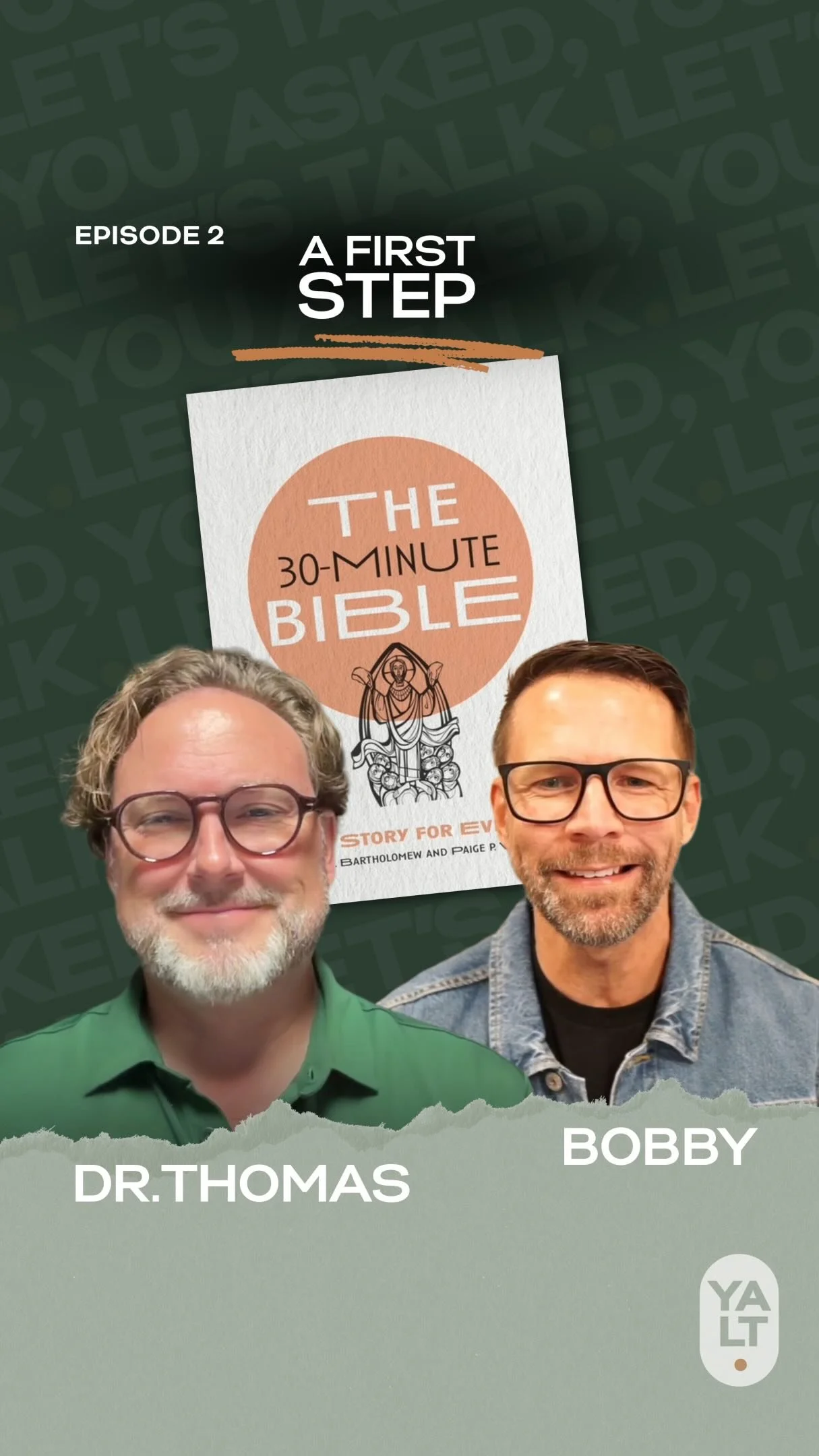
In this week’s conversation on You Asked, Let’s Talk, Dr. Heath Thomas gave us a better starting point. He said the God of the Old Testament is not the God of death. He is the God of life.
That sentence reframes the room.
Because the Bible does not begin with war. It begins with creation. It begins with God speaking light into darkness, filling the world with beauty, and forming a place where human beings could live with Him. Genesis 1:31says, “And God saw everything that he had made, and behold, it was very good.”
That is the first picture.
God is not introduced as a hot-tempered deity looking for someone to punish. He is Creator. He makes life. He blesses life. He calls creation good. He calls humanity very good.
So when we run into the hard parts later, we are already inside a story that began with goodness.
The problem comes when humanity tries to live apart from God. That is not only Adam and Eve’s story. It is ours too. We want life on our own terms. We want wisdom without surrender. We want freedom without trust. And when that breaks, it breaks badly.
That is where the Old Testament starts to feel complicated. God is not dealing with a clean world. He is moving toward a fractured one. He calls Abraham and says, “In you all the families of the earth shall be blessed.” That blessing is not meant to stop with one family or one nation. Israel is called to be a people through whom the world can see the one true God.
That helps explain why some of the language around Israel is so serious. If they are called to be a channel of blessing, then their rebellion affects more than themselves. Heath used the image of a lighthouse people. Their calling was to stand in the world in a way that helped the nations see God.
When the people of God turn away from God, the light gets clouded. The channel gets clogged. The witness breaks down.
That is why discipline shows up in the story. And discipline is easy to misunderstand.
For many of us, discipline sounds like punishment. It sounds like anger. It sounds like, “Wait until your father gets home.” But in Scripture, discipline is often about correction, restoration, and bringing people back to life with God. A loving parent does not correct a child because the child no longer belongs. Correction often happens because the child does belong.
The Old Testament also gives us a direct window into God’s own description of Himself. In Exodus 34:6, God passes before Moses and says, “The Lord, the Lord, a God merciful and gracious, slow to anger, and abounding in steadfast love and faithfulness.”
Slow to anger.
That phrase belongs in the Old Testament.
Merciful and gracious belongs there too. So does steadfast love.
Of course, the same passage goes on to say God does not ignore evil. That also belongs in the picture. A God of life cannot shrug at everything that destroys life. Evil is not a small thing. Injustice is not a side issue. Sin breaks people, families, communities, and nations.
So yes, the Old Testament shows God judging sin. It also shows God rescuing, blessing, creating, forgiving, sustaining, and staying faithful to people who keep wandering.
That may not solve every hard passage for you today. It probably won’t. Some questions take time. Some passages need context. Some things deserve a slower conversation than a short article can give.
But it can change the way you approach the Old Testament.
Instead of starting halfway through the story, start at the beginning. Start with a God who creates life and calls it good. Start with a God who blesses Abraham so the nations can be blessed. Start with a God who describes Himself as merciful, gracious, slow to anger, and full of steadfast love.
Then when you hit the hard parts, don’t abandon the quest.
Ask better questions.
What has gone wrong? What is God protecting? How is God preserving life? How is He ensuring His plan for the world is fulfilled? How does this fit with the God we see fully in Jesus? Where am I in the story?
The Old Testament is not always easy. It was never meant to be treated like an encyclopedia entry, skimmed for quick facts and placed back on the shelf. It is story, law, poetry, prophecy, wisdom, warning, grief, worship, and hope. It asks us to slow down.
So here is one step for this week.
Read Genesis 1 and Exodus 34:6-7. Notice the first picture of God and the way God names Himself. Then ask: what if the Old Testament is not hiding a different God, but inviting me to see the same God more clearly?
That is a good question for the road.
And this road is worth walking.
Follow us on social!